Bedroom
Bedroom gallery wall — calm compositions, headboard rules, and 5 layouts.
By Ömer İlhan · Updated May 11, 2026 · 9 min read
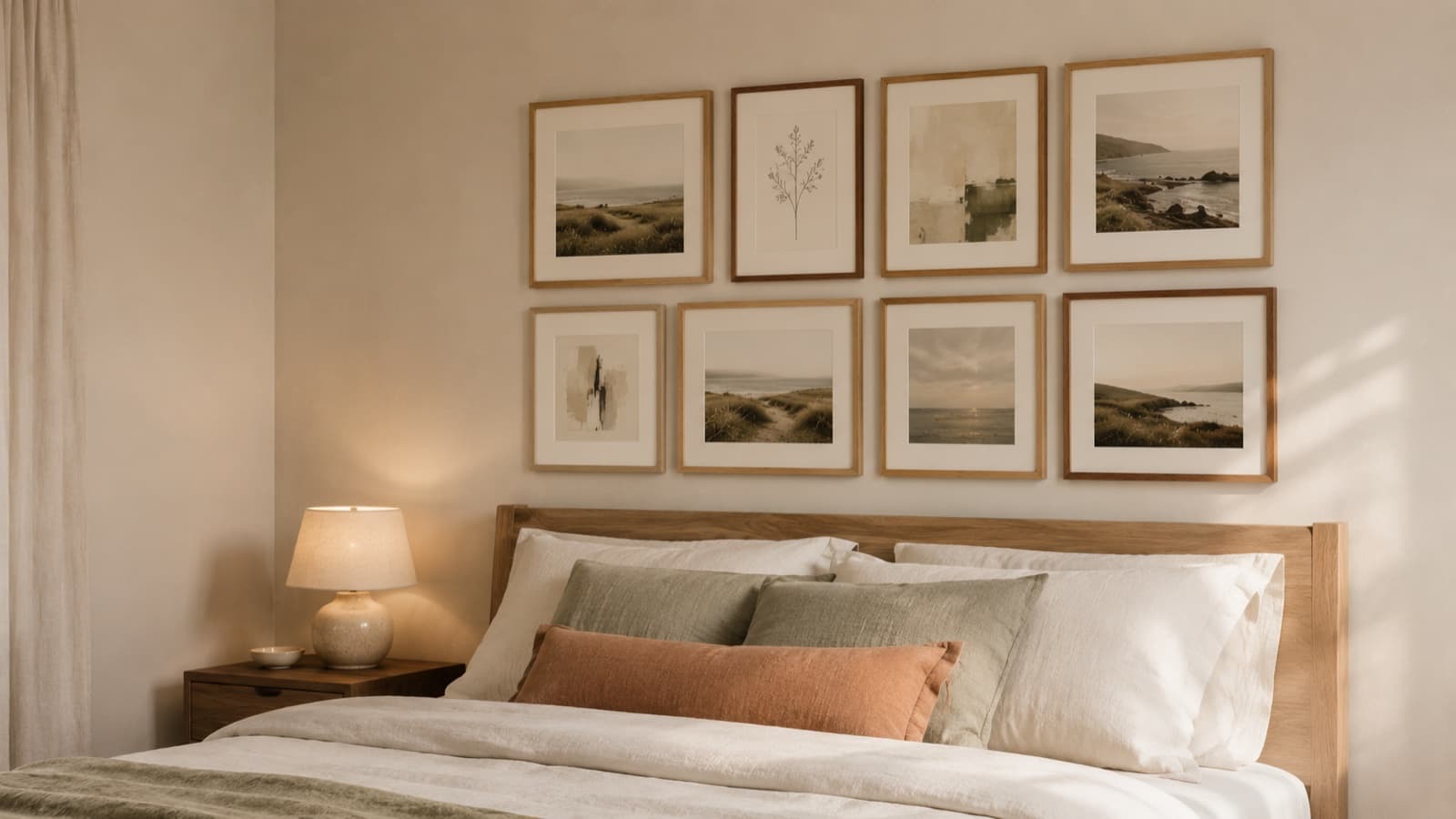
The bedroom is the one room a gallery wall has to actively help you sleep in. That sounds soft until you remember that your brain reads visual complexity even with eyes closed — there's a reason hotel rooms run two muted prints over the bed and never a salon-style cluster. The bedroom rules diverge from the living-room ones almost completely: composition gets calmer, materials get safer, color gets quieter, and the headboard dictates everything.
The headboard rule (clearance and width)
Above the bed, the gallery rules are tighter than any other room in the house. Two non-negotiables:
- Clearance: the bottom edge of the lowest frame sits 15–20 cm above the top of the headboard. Tighter than 15 cm and the gallery visually collides with the headboard; wider than 20 cm and the headboard and gallery feel disconnected.
- Width: the gallery should match the headboard width or sit slightly inside it. Never overhang the headboard. A gallery wider than the headboard reads as visual overflow — the eye finds the edge before it finds the composition.
If you don't have a headboard, treat the mattress width as the headboard width. A queen mattress (152 cm) wants a 130–150 cm wide gallery; a king (193 cm) wants 165–190 cm.
Safer materials over a sleeping head
A framed print falling onto a face during a 3am earthquake or building shake is the rare gallery-wall failure mode that turns into a real injury. Five mitigations, in order of how much risk they remove:
- Use canvas or framed prints with acrylic glazing (Plexiglas, museum acrylic) instead of framed prints with glass. Acrylic shatters less catastrophically and weighs a third as much. Most online framers offer this as a glazing option for $10–30 extra per piece.
- Use heavy-duty hardware rated for at least 2× the frame weight. D-rings + wire on studs (not drywall anchors) for anything over 30×40 cm.
- Keep frame size modest. Above-bed isn't the place for a 100×140 cm anchor. 30×40 to 50×70 is the safe range — large enough to read, small enough that a fall won't cause real damage.
- Use shadow-mount tape on the bottom corners after hanging — small museum-grade putty pads keep frames from swinging or tilting forward during minor shakes.
- Avoid heavy ornate frames in earthquake zones (California, Japan, Turkey, Italy). Lightweight thin-profile frames over the bed; save the ornate gilt for living-room walls.
Color and content choices for sleep
The brain reads color and content even at low conscious attention. A bedroom gallery should support sleep, not compete with it. Three guidelines that consistently work:
- Lower saturation across the board. Faded photographs, muted watercolors, ink drawings, line art. Skip electric-blue abstracts and high-contrast graphics — fine for a hallway, wrong for a bedroom.
- Avoid faces looking at you. Portraits with direct eye contact pull the brain into social-attention mode. Profile portraits, figures looking away, or non-figurative work (landscapes, abstracts, botanicals) all work. Wedding photos go on a dresser, not a gallery above the bed.
- Bias warm and earthy. Warm neutrals, terracotta, dusty greens, soft browns. The palette of a sunset or a forest, not the palette of a retail store. Cool tones work too if your bedroom is already warm-bias, but warm + cool together feels unresolved.
Five bedroom layouts that work
These are the five compositions we keep returning to in bedrooms. Each assumes a queen or king bed with a 150–200 cm wide headboard.
01 — Horizontal triptych
Three 30×40 cm framed prints in a single row, 5 cm gaps.
The calmest bedroom gallery. Total span ~110 cm, fits a queen headboard cleanly. Use a single subject family — botanical, photography, or watercolor — for maximum calm. Hangs 18 cm above headboard top.
02 — Two-piece pair
Two 40×50 cm framed prints, side by side, 8 cm gap.
The minimalist option. Reads as a pair, not a gallery. Perfect for small bedrooms or for couples who want to split the wall into a his/hers symmetry without it feeling literal. Total span ~88 cm.
03 — Single statement piece
One 60×90 cm framed print, centered above the headboard.
The cheapest bedroom layout if the piece carries weight. Best for landscape photography, minimalist abstracts, or large-format botanicals. Hangs 18 cm above headboard. Confidence over complexity.
04 — Tight grid (2×2)
Four identical 30×40 cm framed prints in a 2x2 grid, 5 cm gaps.
The disciplined option. Reads modern and architectural. Works well over a king bed or against a tall headboard. Total span ~85 cm × 85 cm. Skip if your bedroom already has strong patterns elsewhere — the grid will feel like extra geometry.
05 — Asymmetric pair
One 50×70 cm anchor offset to one side, one 30×40 cm satellite stacked above and to the other side.
The dynamic option. Best for bedrooms where the bed is offset against the wall (one side closer to a corner). The asymmetry mirrors the room's geometry without being chaotic. Anchor's vertical center sits at gallery eye level.
Above-bed vs. side-of-bed walls
If the wall above your bed is too short, too sloped, or otherwise wrong for a gallery, the side walls are an underrated alternative. A small gallery on the wall opposite the bed becomes the first thing you see when you wake up — a role the above-bed wall can't play (you can't see what's above you).
Side-wall galleries follow the standard gallery eye-level rule (145–155 cm from floor). Width matches the wall, not the bed. Mount lower than living-room galleries because viewing happens from sitting up in bed (eye level ~130 cm) rather than standing.
Mock the layout before you commit
Bedrooms are where layout iteration matters most, because the space invites you to live with the wall every morning and evening. Mock up before nails go in. Either tape paper templates to the wall or use a digital planner.
Our free designer lets you set the wall to your headboard width, drag prints into place at real scale, and preview the composition before you commit. No signup, runs in your browser.
Frequently asked
- What's the best gallery wall layout for a bedroom?
- Calmer layouts win in bedrooms. Five workable options: horizontal triptych (three identical landscape prints), two-piece pair (two matched frames side by side), single statement piece (one large piece centered), tight 2×2 grid (four identical frames), and asymmetric pair (one anchor + one satellite). Skip salon-style clusters — too much visual complexity for a sleep environment.
- Is it safe to hang art with glass above a bed?
- It's the rare gallery-wall failure mode that turns into real injury during minor earthquakes or building shake. Replace glass glazing with acrylic (Plexiglas, museum acrylic) — one-third the weight, shatters into dull pieces rather than shards. Most online framers offer it as a $10–30 upgrade per piece. Or use canvas or unframed prints, which sidestep the question entirely.
- How wide should a bedroom gallery wall be?
- Match the headboard width or sit slightly inside it. Never overhang the headboard — a gallery wider than the headboard reads as visual overflow. Queen headboard (typically 165 cm): gallery 130–160 cm wide. King headboard (typically 200 cm): 160–195 cm. Without a headboard, treat the mattress width as the headboard width.
- What colors work best in a bedroom gallery?
- Lower-saturation art across the board: faded photographs, muted watercolors, ink drawings, line art. Bias warm and earthy — warm neutrals, terracotta, dusty greens, soft browns. Skip electric-blue abstracts, high-contrast graphics, and saturated primaries. The brain reads color even at low conscious attention; calm colors support sleep, busy colors compete with it.
- Should I avoid faces in bedroom art?
- Direct eye contact in portraits pulls the brain into social-attention mode. For above-bed art, skip portraits with direct eye contact. Profile portraits, figures looking away, and non-figurative work (landscapes, abstracts, botanicals) all work. Wedding photos and family portraits belong on a dresser, not in a gallery above the bed.
- How high above the headboard should art hang?
- The bottom edge of the lowest frame sits 15–20 cm above the top of the headboard. Tighter than 15 cm and the gallery visually collides with the headboard; wider than 20 cm and the headboard and gallery feel disconnected. Measure from the headboard top, not the mattress.
Plan your bedroom gallery on screen.
Set the wall to your headboard width, drag prints into place, and preview the composition at real centimeters before you drive a single nail.
Open the gallery wall designerKeep planning
Published 2026-05-07. Updated 2026-05-07.