Mirror style
Mirror gallery wall — light, depth, and a mixed-frame approach that works.
By Ömer İlhan · Updated May 11, 2026 · 9 min read
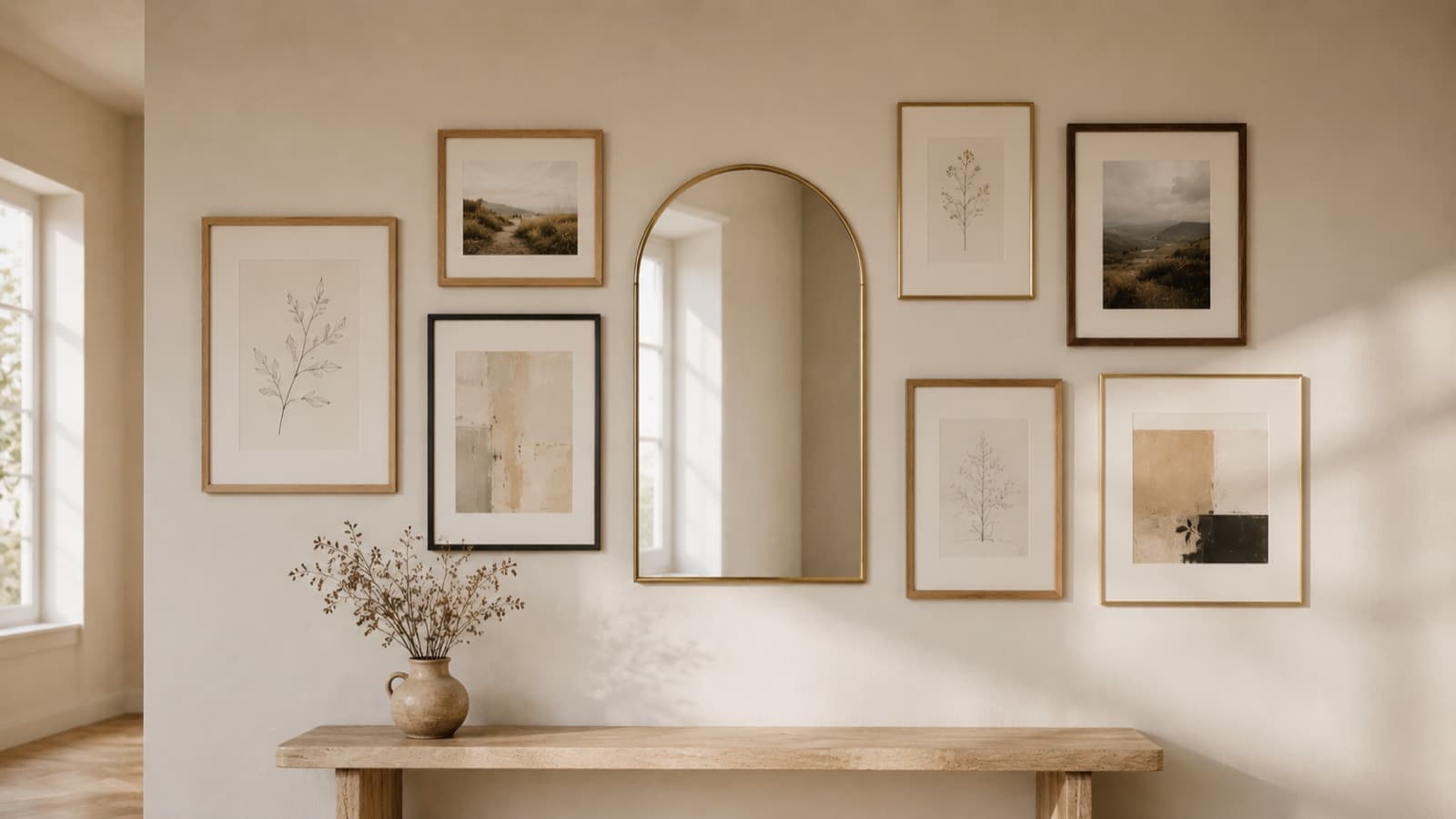
A mirror gallery wall is one of the most under-used compositions in interior design. Done right, mirrors do three things at once that no other gallery element can: they bounce real light into dim corners, they read as art without committing to a subject, and they create the illusion of a room twice the actual size. Done badly, mirrors fight the rest of the wall — too many mirrors and the composition reads as a fitting room. The difference is one rule and a small set of finish decisions.
What a mirror gallery wall does for a room
Mirrors solve specific room problems. Knowing which problem you're solving determines the layout.
- Bouncing light: a mirror across from a window doubles the apparent brightness of a room. In a dim corner, a single well-placed mirror can change the perceived light level more than three new lamps.
- Faking square footage: a mirror cluster on a long wall in a narrow room makes the room read as wider. The reflection extends the visual depth perpendicular to the wall.
- Pulling in views: a mirror angled at a window or doorway captures the view in another part of the room and re-frames it on a different wall. Underrated trick — works especially well for compositions opposite a kitchen window or a doorway with a view.
- Adding depth without adding subject: in a room with too many decisions already (busy fabric, bold rug, strong color), mirrors add visual interest without piling on more subject matter. The reflection becomes the content.
The mirror density rule (one per four frames)
The single most useful rule for a mirror gallery wall: the ratio of mirrors to framed pieces should sit at roughly 1:4 or sparser. One mirror in a six-piece composition reads as an accent. Two mirrors read as a deliberate pair. Three or more mirrors on the same wall read as a fitting room or a hotel lobby.
The 1:4 ratio holds across composition styles. Tight grids, salon clusters, asymmetric arrangements all follow it. The exception is a composition built explicitly around mirrors — three to five mirrors of varying shapes and sizes with no framed pieces — but that's a different design exercise from a mirror gallery wall, which by definition mixes mirrors with framed art.
The mirror should be one of the two largest pieces in the composition. A small accent mirror in a sea of large frames reads as an afterthought; a large mirror among small frames reads as the anchor it's meant to be.
Frame finish coordination across mirror and frames
The mirror frame and the framed-art frames need to belong to the same finish family or the wall reads as two unrelated galleries. Three approaches that work consistently:
- Match exactly. Mirror frame and at least one framed-art frame share an identical finish (both gold, both matte black, both natural wood). Reads intentional, almost matched-set.
- Echo within a family. Mirror in antique gold, frames in burnished brass or aged wood — different exact finishes but same warm/cool family. Reads as collected over time.
- Frameless mirror as accent. A frameless or thin-edge mirror reads as a window, not as a competing frame. The mirror disappears into the wall while reflecting the room. Works in modern compositions where ornate framing would clash.
The mistake to avoid: contrasting finishes across mirror and frames (matte black mirror + gold frames, for example). The contrast pulls the eye to the mirror as a separate element and the gallery loses cohesion.
Room-specific applications
Mirror galleries work better in some rooms than others.
- Entryway: the highest-impact room for a mirror gallery. The mirror doubles as a useful object (last-look check before leaving the house). Compose with 3–4 small framed pieces and one mid-sized mirror at face height.
- Dining room: mirror across from a window reflects candlelight or pendant fixtures during meals. Use one large mirror as the anchor; framed art surrounds it.
- Hallway: long narrow hallways benefit from mirrors that visually widen the space. Two mirrors spaced along the hallway, paired with framed art between them.
- Living room: cautious yes — works best when the mirror sits opposite a window so the reflection doubles natural light. Avoid if the mirror would reflect a TV.
- Bedroom: cautious no for above-bed. A mirror reflecting your face while you sleep is a personal-preference call (some cultures and superstitions advise against it; others don't care). Side walls are safer.
Five mixed-mirror layouts that work
These are the five compositions we keep returning to in mixed-mirror walls. Each holds the 1:4 mirror-to-frame density.
01 — Mirror anchor, four frame satellites
One 60×80 cm mirror centered, four 30×40 cm framed prints arranged around it.
The classic mirror-gallery composition. Mirror is the anchor; frames orbit. Best for entryways and dining rooms. Mirror sits at adult eye height (155–165 cm from floor).
02 — Asymmetric trio with offset mirror
One 50×70 cm mirror offset to one side, three 30×40 cm frames stacked on the other.
Reads dynamic, intentional. Best for narrow walls or compositions that need to balance against an architectural feature (doorway, window). Mirror's reflection captures whatever sits at the offset side of the room.
03 — Tall narrow mirror flanked by two columns of frames
One 40×120 cm leaner-style mirror centered, two columns of three 25×35 cm frames flanking.
Reads architectural, formal. Best for entryways and dining rooms with high ceilings. The vertical mirror counters the horizontal pull of the framed columns.
04 — Round mirror in salon-style cluster
One 50 cm-diameter round mirror as the anchor, surrounded by 6–8 mixed-size framed pieces at salon-style density (3 cm gaps).
Reads vintage, collected, eclectic. The round mirror breaks the rectangular rhythm of the salon cluster. Best for vintage gallery walls and rooms with strong existing visual character.
05 — Sunburst mirror centerpiece
One 60 cm sunburst or starburst mirror centered, four 25×30 cm framed prints in a cross pattern around it.
The most decorative option. Reads warm, mid-century, deliberately styled. Best for rooms with mid-century furniture or warm metallic palettes. Skip if the room is otherwise minimalist.
Common mirror gallery mistakes
- Too many mirrors. More than one in a six-piece composition; more than two in any composition. Hard cap.
- Mirror reflects something ugly. Walk in front of the wall before hanging the mirror. Whatever the mirror reflects becomes a visible part of the composition. A mirror reflecting a TV, a radiator, or a cluttered shelf is a permanent design flaw.
- Frame-finish mismatch. Mirror and frames in completely different finishes (matte black mirror + gold frames). Stick to one finish family.
- Mirror too small. A 30×40 cm mirror in a wall full of 50×70 frames reads as an oversight. The mirror should be one of the two largest pieces.
Mock the layout before you commit
Mirrors are heavier than frames at equivalent size, which makes them less forgiving to rehang. Mock the composition before committing.
Our free designer lets you set the wall, drag mirrors and frames into place, and preview the composition at real wall scale before you touch a hammer. Faster than tape templates, especially for heavy-mirror layouts.
Frequently asked
- How many mirrors should be on a gallery wall?
- The mirror-to-frame ratio should sit at roughly 1:4 or sparser. One mirror in a six-piece composition reads as an accent. Two mirrors read as a deliberate pair. Three or more mirrors on the same wall read as a fitting room or hotel lobby. The mirror should be one of the two largest pieces in the composition.
- What rooms work best for a mirror gallery wall?
- Entryways are highest-impact (the mirror doubles as a useful object). Dining rooms benefit from mirrors opposite windows that reflect candlelight or pendant fixtures. Long narrow hallways gain perceived width from spaced mirrors. Living rooms work cautiously when the mirror sits opposite a window. Bedrooms work on side walls but not above the bed (a mirror reflecting your face during sleep is a personal-preference call).
- Should mirror frames match the picture frames?
- They need to belong to the same finish family. Three approaches work: match exactly (mirror frame and at least one art frame share an identical finish), echo within a family (mirror in antique gold, frames in burnished brass or aged wood), or use a frameless mirror that disappears into the wall. Avoid contrasting finishes across mirror and frames — matte black mirror + gold frames pulls the eye to the mirror as a separate element.
- Where should I place a mirror in a gallery wall?
- The mirror should be one of the two largest pieces in the composition, anchored at adult eye height (155–165 cm from floor) when the wall is for entryways or dining rooms. In asymmetric compositions, offset the mirror to one side and let smaller frames balance against it. Walk in front of the wall before hanging — whatever the mirror reflects becomes a permanent visible part of the composition.
- Can I have only mirrors on a gallery wall?
- Technically yes — three to five mirrors of varying shapes and sizes can compose a deliberate mirror-only wall. But that's a different design exercise from a mirror gallery wall, which by definition mixes mirrors with framed art. Mirror-only walls work best in entryways and powder rooms; mixed-mirror compositions are more flexible across rooms.
- Does a mirror gallery wall make a room look bigger?
- Yes, when placed correctly. A mirror across from a window doubles the apparent brightness of a room. A mirror cluster on the long wall of a narrow room makes the room read as wider. The reflection extends visual depth perpendicular to the wall. Mirrors angled at a window or doorway can pull a view from another part of the room into the composition.
Plan your mirror gallery on screen.
Set the wall, drag mirrors and frames into place, and preview the composition at real centimeters before you drive a single nail.
Open the gallery wall designerKeep planning
Published 2026-05-07. Updated 2026-05-07.